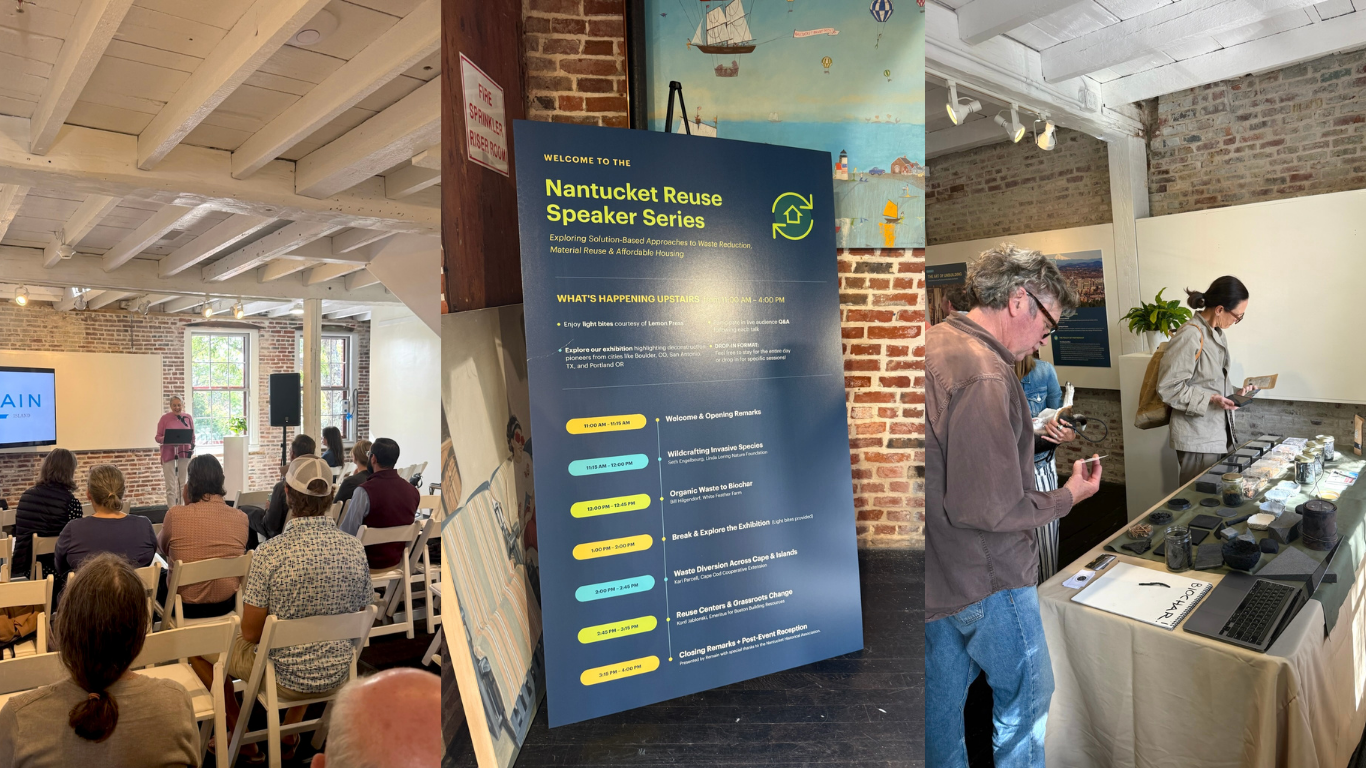
Nantucket Reuse Speaker Series: Session Summaries
Nantucket generates a minimum of 17,000 tons of construction and demolition debris each year. On Saturday, Sept. 19, Remain brought four regional experts to the Thomas Macy Warehouse to talk about what that material, along with the island’s invasive plants, organic waste and household trash, could become instead.
The free Nantucket Reuse Speaker Series took place in a building constructed after the Great Fire of 1846 to serve the whaling industry, a fitting setting for an island with a long tradition of salvage and adaptive reuse. Each session paired a presentation with audience Q&A. Topics ranged from wildcrafting invasive species and turning woody waste into biochar to where Cape and Islands trash goes when we throw it “away” and how building material reuse centers keep cabinets, appliances and lumber in use. Between talks, guests explored a 10-panel exhibition on deconstruction and reuse in Boulder, San Antonio and Portland.
One idea connected all four sessions: much of what leaves the island as waste still has value, and capturing it starts with small, practical steps. The summaries below highlight each speaker’s key ideas and what they could mean for Nantucket.
Wildcrafting: Putting Invasive Species to Use
Seth Engelbourg, Linda Loring Nature Foundation
Invasive species are usually pulled, mowed or sprayed, then sent to the landfill. Seth Engelbourg, director of education and interpretation at the Linda Loring Nature Foundation, made the case that this throws away a free resource. Wildcrafting, the practice of harvesting from nature and turning it into food, medicine or craft materials, offers a way to put some of that material to use.
Engelbourg defined invasive species as non-native organisms that cause ecological, economic or public health harm, and noted that people, not the species, created the problem. Through the Nantucket Biodiversity Initiative’s Invasive Plant Species Committee, he helped establish a dedicated invasive species dumpster at the Nantucket landfill. Material left there goes through the digester, which gets hot enough to kill reproductive plant material. Invasives dumped on the landfill’s compost pile, by contrast, can spread.
Food: Young Japanese knotweed shoots bake into a pie much like rhubarb, garlic mustard stands in for basil in pesto, and green crabs, carp and golden grove bamboo shoots are all edible.
Medicine: Japanese barberry root bark contains berberine, and autumn olive berries work as an astringent. Engelbourg encouraged anyone exploring these uses to consult a doctor.
Craft: Purple loosestrife is a traditional hair dye. Miscanthus, or Chinese silver grass, was recently listed as prohibited in Massachusetts and has long been used for paper in East Asia.
On Nantucket now: The foundation’s pollinator hotel shelters solitary bees in tubes cut from bamboo, knotweed and phragmites. The Maria Mitchell Association, Sustainable Nantucket and the Nantucket Land & Water Council have turned green crabs into fertilizer.
Engelbourg also pointed to an untapped opportunity. The town’s Natural Resources Department buys bamboo stakes from off-island for its shorebird nesting fencing, while groves of golden grove bamboo grow in Madaket, Sconset and elsewhere on the island. Audience members suggested working with landowners to salvage bamboo when groves are cleared.
He does not expect invasive species to support an island industry, but sees room for cottage businesses, partnerships between organizations and personal projects. Diverting even 1% is better than nothing, he said, as long as plants treated with herbicide are never eaten. In his words, “trash is just treasure that people have given up on.”
Biochar: Turning Organic Waste Into Healthy Soil and Stored Carbon
Bill Hilgendorf, White Feather Farm
Biochar is made by heating wood scraps, invasive plants or other organic waste in a low-oxygen fire. The process burns off gases and tars but leaves the plant’s carbon structure intact, producing a porous, sponge-like material that can last in soil for hundreds or even thousands of years. Bill Hilgendorf, who leads research and education at White Feather Farm in Saugerties, N.Y., explained that biochar can hold onto as much as half of a plant’s carbon, rather than letting nearly all of it return to the atmosphere as the plant decays or burns.
A former furniture maker who built collections from salvaged Coney Island boardwalk and bourbon barrels, Hilgendorf turned to biochar as a way to reach a larger scale of climate impact.
Soil: Biochar holds about five times its weight in water and stores nutrients until plants need them. Amazon soils enriched by Indigenous peoples more than 2,000 years ago remain dark and productive today.
Compost: Mixed into compost, biochar can speed decomposition by 20% to 25% and reduce odors.
Water: At White Feather Farm, biochar has captured nutrient runoff from fields and cleared algae from a pond. It can also help filter stormwater.
Research: The farm is part of a five-year national field trial with American Farmland Trust and Cornell University.
Emerging uses: Researchers and companies are testing biochar in concrete, building insulation and battery components.
Audience members named possible island feedstocks, including pines killed by the southern pine beetle, invasive plants and construction scraps, and suggested blending biochar into compost from the island’s organics stream. Hilgendorf pointed to municipal programs in Stockholm, Sweden, and to U.S. projects underway with support from Bloomberg Philanthropies. He recommended starting small and proving the concept before scaling up. Town of Nantucket staff noted that any system would need to match the island’s volume, types of waste and seasonal swings.
Biochar can also be made at home in a metal fire bowl, a 55-gallon drum or a charcoal grill with the bottom vents closed. Load it with clean wood, let it burn hot, and quench it with water once the flames die down. Hilgendorf advised against burning pressure-treated or painted wood.
Where Is “Away”? Waste Across the Cape and Islands
Kari Parcell, Cape Cod Cooperative Extension
Massachusetts disposes of about 6 million tons of waste each year. Roughly half is burned at the state’s five waste-to-energy facilities, about 650,000 tons go to in-state landfills and about 2.2 million tons are shipped out of state. Kari Parcell, who works with 33 communities across Cape Cod, the islands and the South Coast on waste reduction, said the trend is heading the wrong way: household waste has risen to about 1,650 pounds, despite a state goal of cutting it 30% by 2030.
The options for handling that waste are narrowing. A moratorium blocks new waste-to-energy capacity, and only two active landfills remain on the Cape and Islands, on Nantucket and in Bourne. Parcell warned that without change, the region’s trash could increasingly travel to places like an expanding facility in Alabama, in an area where average income is about $17,000 a year. Yet about 85% of what lands in a typical kitchen trash can could be recycled, composted or otherwise diverted.
Pay-as-you-throw: Charging by the bag encourages people to think about what they discard. Parcell credited it, along with slower population growth, for Martha’s Vineyard’s lower household waste figures.
Extended producer responsibility: Requiring manufacturers to take back products such as mattresses and paint for recycling. Several bills are pending in Massachusetts, and towns can also act locally.
Regional diversion programs: Collections for holiday string lights, boat shrink wrap (with Woods Hole Oceanographic Institution), latex paint, household hazardous waste and food scraps.
Community composting: A proof-of-concept composting facility is in development at Joint Base Cape Cod to serve upper Cape towns.
Education: Explaining why a rule exists, not only what it is, and reaching every part of the community, including seasonal residents and workers.
During Q&A, Town of Nantucket solid waste staff noted that state comparisons do not capture the island’s full picture. Nantucket has no municipal curbside collection, manages waste on-island and already separates many streams, from textiles and mattresses to invasive plants and clean wood. Parcell agreed that state waste maps can be skewed by how towns report their data.
Residents can look up how to dispose of more than 800 items in the Nantucket Waste app. Textiles, including stained or torn clothing, can be dropped off at the Take It or Leave It throughout the week, where staff sort what can be reused.
Building Material Reuse: A Shift in Mindset
Kord Jablonski, Emeritus, Boston Building Resources
Buildings account for about 40% of global carbon emissions, and building materials alone for about 11%. Kord Jablonski, former executive director of Boston Building Resources, put that in household terms: 10 feet of kitchen cabinets and countertop carries about 5 metric tons of embodied carbon, roughly a third of the average American’s annual emissions of about 15 tons.
To see where Boston’s construction debris ends up, Jablonski’s team dropped tracking devices into dumpsters around the city. Massachusetts ships about 2 million tons of construction and demolition debris out of state each year, and several trackers landed at a landfill in Rensselaer, N.Y., next to a school and playground in a low-income neighborhood. For Nantucket, he noted, “away” is often Ohio.
Boston Building Resources, whose founder launched the block-captain recycling effort that grew into Boston’s residential recycling program, offers a working model for reuse:
A small footprint: Its 9,000-square-foot store sells about $2 million in reused materials a year, as much as centers five to 10 times larger, by pricing items around 25% of retail and moving inventory fast.
A community mission: About 70% of sales go to lower-income households, who receive a discount, and hands-on workshops teach skills like installing doors and trim.
Deconstruction as a service: Paid crews remove cabinets, appliances, fixtures, doors and lighting before renovations, after the contractor disconnects utilities. With high disposal fees, this is often cheaper than dumping and, with good planning, neutral to project timelines.
Training the next generation: Partnerships with YouthBuild Boston and the Boston Architectural College bring reuse into trades and design education. Students recently built a reuse pavilion from nearly 90% salvaged materials, mostly doors, with funding from MassDEP.
Committed funders: Philanthropy covers about 30% of the budget. Liberty Mutual, its largest funder, supports the work for its climate benefits.
Jablonski also shared what reuse makes possible. In Dorchester, two former bakery owners built 14 affordable units for under $1 million in hard costs, fitting them out largely with salvaged tile, fixtures, flooring and lumber, and working with the city to change zoning for 300-square-foot homes that rent for $850 a month. In Abington, a church moved into a former firearms store, finished with reclaimed materials.
His advice for Nantucket: start with what is easy and in demand, such as cabinets, appliances and plumbing fixtures, and don’t let perfection be the enemy of progress. When he told shoppers the kitchen cabinet carbon story, about one in five stopped to consider reused cabinets instead. He encouraged attendees to become evangelists for that same shift on the island.
Looking Ahead
Across four very different talks, the message was consistent: the material Nantucket sends away each year is a resource, and putting it to use begins with practical steps. A patch of garlic mustard becomes pesto, a bin of wood scraps becomes biochar, and a kitchen’s worth of cabinets finds a second home.
Remain thanks Seth Engelbourg, Bill Hilgendorf, Kari Parcell and Kord Jablonski for sharing their expertise, the Nantucket Historical Association for hosting the series at the Thomas Macy Warehouse, Lemon Press for refreshments, and everyone who spent a beautiful September Saturday with us.
About Remain
Remain engages in creative environmental and community work, elevates local industry, and encourages innovation and resilience. Remain Nantucket and Remain Ventures are funded by Wendy Schmidt and Eric Schmidt to support the island’s year-round economy, community, and environmental vitality.
For more information, email info@remain.org.